Description
Research overview
BPC-157 Research Background
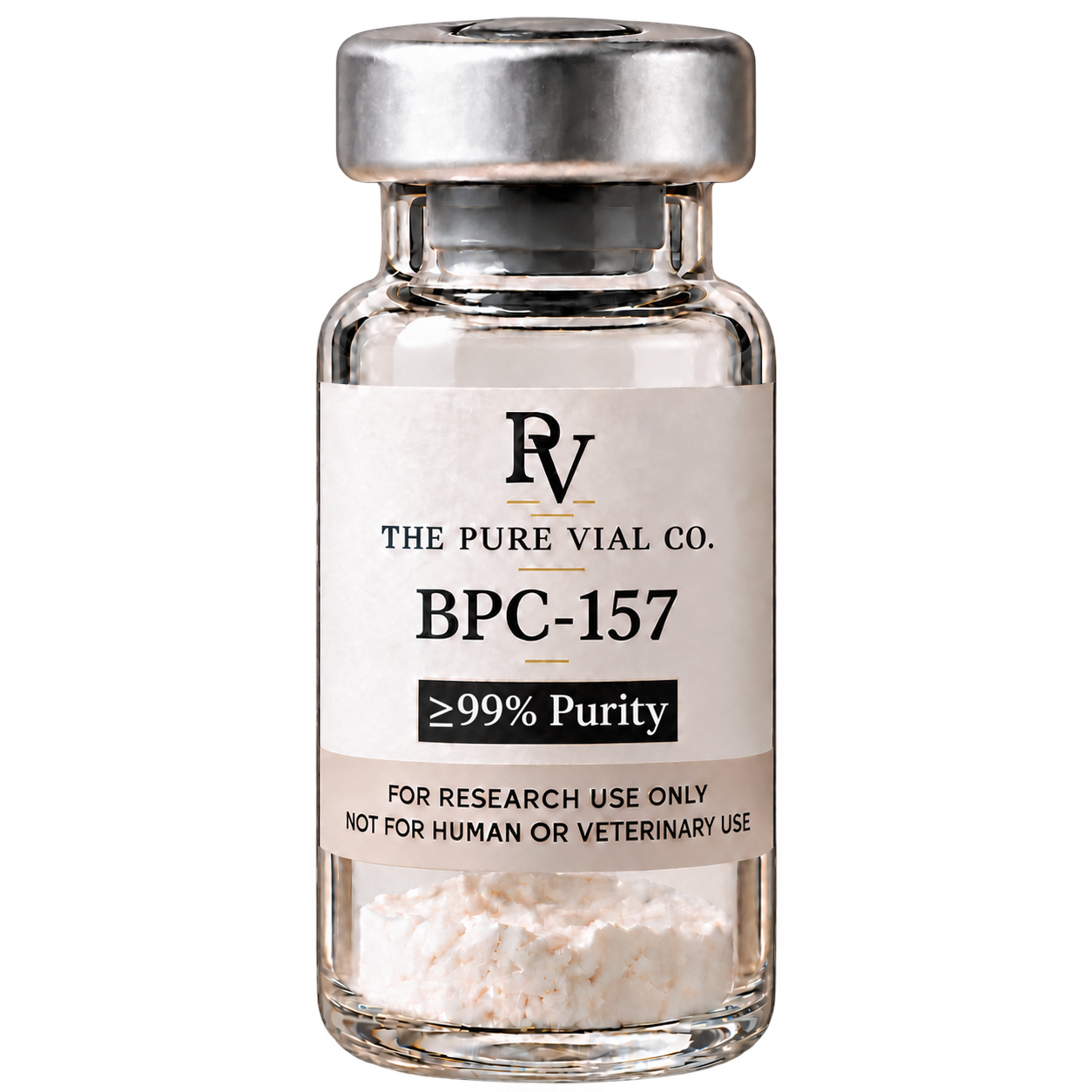
BPC-157 (Body Protection Compound-157) is a synthetic pentadecapeptide: a stable, partial sequence corresponding to a fragment of a protein identified in gastric juice. Its 15-residue chain (Gly-Glu-Pro-Pro-Pro-Gly-Lys-Pro-Ala-Asp-Asp-Ala-Gly-Leu-Val) is not found intact in nature, and it is produced synthetically for laboratory work. Within the research literature the compound is often described as a “stable gastric pentadecapeptide,” a label that reflects its notable resistance to hydrolysis in aqueous and enzymatic conditions relative to many short peptides. This characterization has made it a frequently cited model compound in mechanistic and gastrointestinal studies.
Interest in BPC-157 as a research material centers on how a small, sequence-defined peptide behaves across a range of in-vitro and preclinical systems. It is used as a reference peptide in assays exploring cellular signaling, angiogenesis-related pathways, and tissue-culture responses. The peptide has no established consumer application, and the body of work surrounding it remains preliminary and ongoing; findings from cell-based and rodent-model studies should not be extrapolated to human or animal outcomes.
What Has Been Studied in Preclinical Models
Published investigations of BPC-157 are predominantly rodent-model and in-vitro in nature. Reported experimental lines of inquiry include interactions with nitric oxide (NO) system pathways, effects observed in cell-migration and wound-closure scratch assays, and studies examining vascular and connective-tissue endpoints in controlled preclinical settings. Researchers have also used it to probe growth-factor receptor expression, such as VEGFR2 signaling, in cultured endothelial cells.
- Cell-culture models examining fibroblast migration and tubule formation.
- Rodent-model studies of connective-tissue and gastrointestinal endpoints.
- Mechanistic work on nitric-oxide-related signaling pathways.
- Stability and receptor-interaction assays used to characterize peptide behavior in vitro.
These references describe experimental laboratory work only. They are not medical claims, are not evidence of safety or efficacy in humans or animals, and should not be interpreted as guidance for any use outside a controlled research environment.
BPC-157 specifications
| Compound | BPC-157 (Body Protection Compound-157) |
|---|---|
| Also known as | Pentadecapeptide BPC 157 |
| CAS number | 137525-51-0 |
| Molecular formula | C62H98N16O22 |
| Molecular weight | 1419.5 g/mol |
| Sequence | Gly-Glu-Pro-Pro-Pro-Gly-Lys-Pro-Ala-Asp-Asp-Ala-Gly-Leu-Val (GEPPPGKPADDAGLV) |
| Form | Lyophilized (freeze-dried) powder |
| Vial contents | 10 mg |
| Purity & identity | Documented on the lot-specific Certificate of Analysis (HPLC purity, mass spectrometry identity) |
| Storage | −20 °C, sealed, dry, protected from light |
| Intended use | Laboratory and analytical research use only. Not for human or veterinary use. |
Storage and handling of lyophilized BPC-157
Store lyophilized material at −20 °C or below, sealed, dry, and protected from light. Short-term storage at 2–8 °C is generally acceptable. Allow the sealed vial to reach room temperature before opening to limit moisture condensation, and minimize repeated temperature cycling.
Frequently asked questions
What is the CAS number of BPC-157?
The CAS Registry Number for BPC-157 is 137525-51-0.
What is the molecular weight of BPC-157?
BPC-157 has a molecular formula of C62H98N16O22 and an average molecular weight of 1419.5 g/mol.
How should lyophilized BPC-157 be stored?
Store lyophilized material at −20 °C or below, sealed, dry, and protected from light. Short-term storage at 2–8 °C is generally acceptable. Allow the sealed vial to reach room temperature before opening to limit moisture condensation, and minimize repeated temperature cycling.
Is a Certificate of Analysis available for BPC-157?
Yes. Each lot is documented with a lot-specific Certificate of Analysis covering identity and purity. Published certificates are listed in our COA Library, searchable by product or lot number.
Is BPC-157 intended for human or veterinary use?
No. BPC-157 is sold strictly for laboratory, analytical, and scientific research. It is not intended for human or veterinary use, diagnosis, or treatment. See our Research Disclaimer.