Description
Research overview
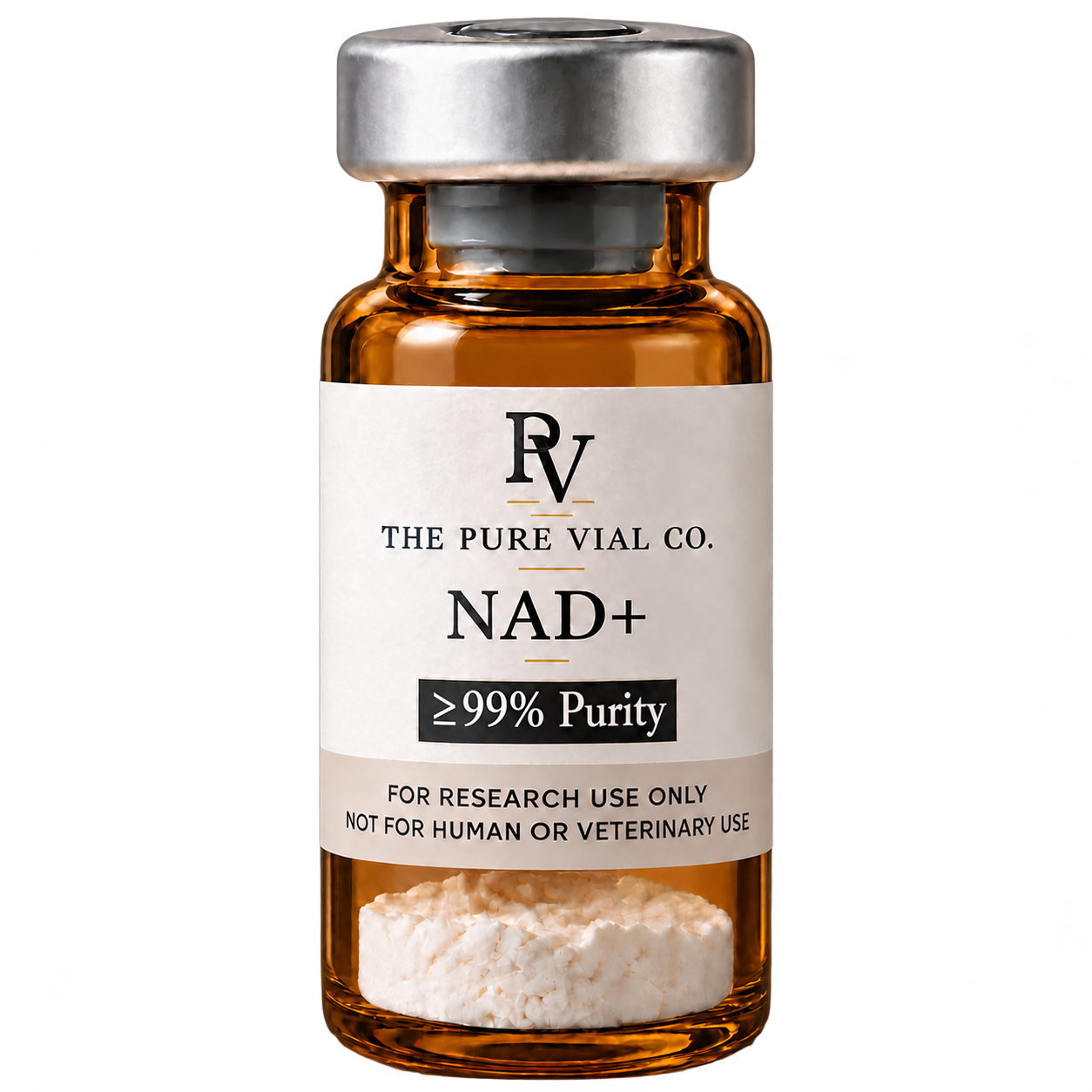
This listing supplies nicotinamide adenine dinucleotide (NAD+) as a 500 mg lyophilized vial intended strictly for in-vitro and preclinical laboratory research. NAD+ is a pyridine dinucleotide built from an adenine-containing nucleotide joined to a nicotinamide-containing nucleotide through a pyrophosphate bridge. In its oxidized (NAD+) and reduced (NADH) forms it functions as a hydride-accepting redox cofactor, and it is a defining reagent for studying electron-transfer chemistry at the bench. The material is offered as a research chemical for characterization work, assay development, and mechanistic investigation only.
NAD+ has been examined extensively in cell-free biochemistry and cultured-cell systems as the electron carrier that couples catabolic dehydrogenase reactions to downstream metabolism. In these research settings it is a standard substrate for enzymes such as lactate dehydrogenase, alcohol dehydrogenase, and the glyceraldehyde-3-phosphate dehydrogenase step of glycolysis, where the NAD+/NADH ratio is used as a readout of cellular redox state.
Beyond its classical redox role, NAD+ has been studied preclinically as a consumed co-substrate rather than a recycled cofactor. Investigators have used it to probe the activity of sirtuin deacylases and poly(ADP-ribose) polymerases (PARPs), both of which cleave NAD+ and release nicotinamide during their catalytic cycles. It also serves as a precursor for signaling molecules including cyclic ADP-ribose. This body of work remains preliminary and ongoing, and the content here describes laboratory observations only; it is not medical advice and implies no health outcome.
- Redox-cofactor kinetics in isolated-enzyme and cell-lysate assays
- NAD+/NADH ratio as a metabolic-state indicator in cultured cells
- Substrate for sirtuin- and PARP-mediated NAD+ consumption studies
- Reference standard for spectrophotometric and fluorometric quantitation
Each batch is characterized to confirm identity and purity before release. Reversed-phase HPLC with UV detection is the primary purity method; NAD+ shows a characteristic absorbance maximum near 259 nm arising from its adenine and nicotinamide chromophores, and the free-acid dinucleotide is resolved from related species such as NADH, nicotinamide, and ADP-ribose degradation products. Purity is typically reported as area-percent against these known impurities.
Identity is confirmed by mass spectrometry, with the expected monoisotopic mass consistent with the C21H27N7O14P2 composition (nominal molecular weight ~663.4 g/mol for the free acid). Complementary techniques used in characterization can include UV-Vis spectroscopy to verify the 259 nm profile, Karl Fischer or loss-on-drying for residual moisture in the lyophilized cake, and appearance/reconstitution checks. Reviewing the batch-specific Certificate of Analysis (COA) is recommended so that reported HPLC purity, mass-spec identity confirmation, and moisture data can be matched to the lot in hand before it is entered into an experimental record.
NAD+ is hygroscopic and its aqueous solutions are sensitive to heat, alkaline pH, and repeated freeze-thaw. Standard laboratory practice is to keep the sealed lyophilized vial cold and desiccated, equilibrate it to room temperature before opening to limit moisture uptake, and reconstitute in cold buffer near neutral or slightly acidic pH immediately prior to an experiment. Prepared stock solutions are commonly aliquoted to minimize freeze-thaw cycles. Handle only with appropriate PPE under general chemical-safety procedures. This material is not for human or animal use.
NAD+ specifications
| Compound | NAD+ (β-Nicotinamide adenine dinucleotide) |
|---|---|
| Also known as | β-NAD, nicotinamide adenine dinucleotide (oxidized form) |
| CAS number | 53-84-9 |
| Molecular formula | C21H27N7O14P2 |
| Molecular weight | 663.4 g/mol |
| Form | Lyophilized (freeze-dried) powder |
| Vial contents | 500 mg or 1000 mg |
| Purity & identity | Documented on the lot-specific Certificate of Analysis (HPLC purity, mass spectrometry identity) |
| Storage | −20 °C, sealed, dry, protected from light |
| Intended use | Laboratory and analytical research use only. Not for human or veterinary use. |
Storage and handling of lyophilized NAD+
Store lyophilized material at −20 °C or below, sealed, dry, and protected from light. Short-term storage at 2–8 °C is generally acceptable. Allow the sealed vial to reach room temperature before opening to limit moisture condensation, and minimize repeated temperature cycling.
Frequently asked questions
What is the CAS number of NAD+?
The CAS Registry Number for NAD+ is 53-84-9.
What is the molecular weight of NAD+?
NAD+ has a molecular formula of C21H27N7O14P2 and an average molecular weight of 663.4 g/mol.
How should lyophilized NAD+ be stored?
Store lyophilized material at −20 °C or below, sealed, dry, and protected from light. Short-term storage at 2–8 °C is generally acceptable. Allow the sealed vial to reach room temperature before opening to limit moisture condensation, and minimize repeated temperature cycling.
Is a Certificate of Analysis available for NAD+?
Yes. Each lot is documented with a lot-specific Certificate of Analysis covering identity and purity. Published certificates are listed in our COA Library, searchable by product or lot number.
Is NAD+ intended for human or veterinary use?
No. NAD+ is sold strictly for laboratory, analytical, and scientific research. It is not intended for human or veterinary use, diagnosis, or treatment. See our Research Disclaimer.